8 Trigrams – from the “I Ching” to Qigong
What if you could learn Qigong by copying the movements of nature?
That is the simple idea behind the Eight Trigrams.
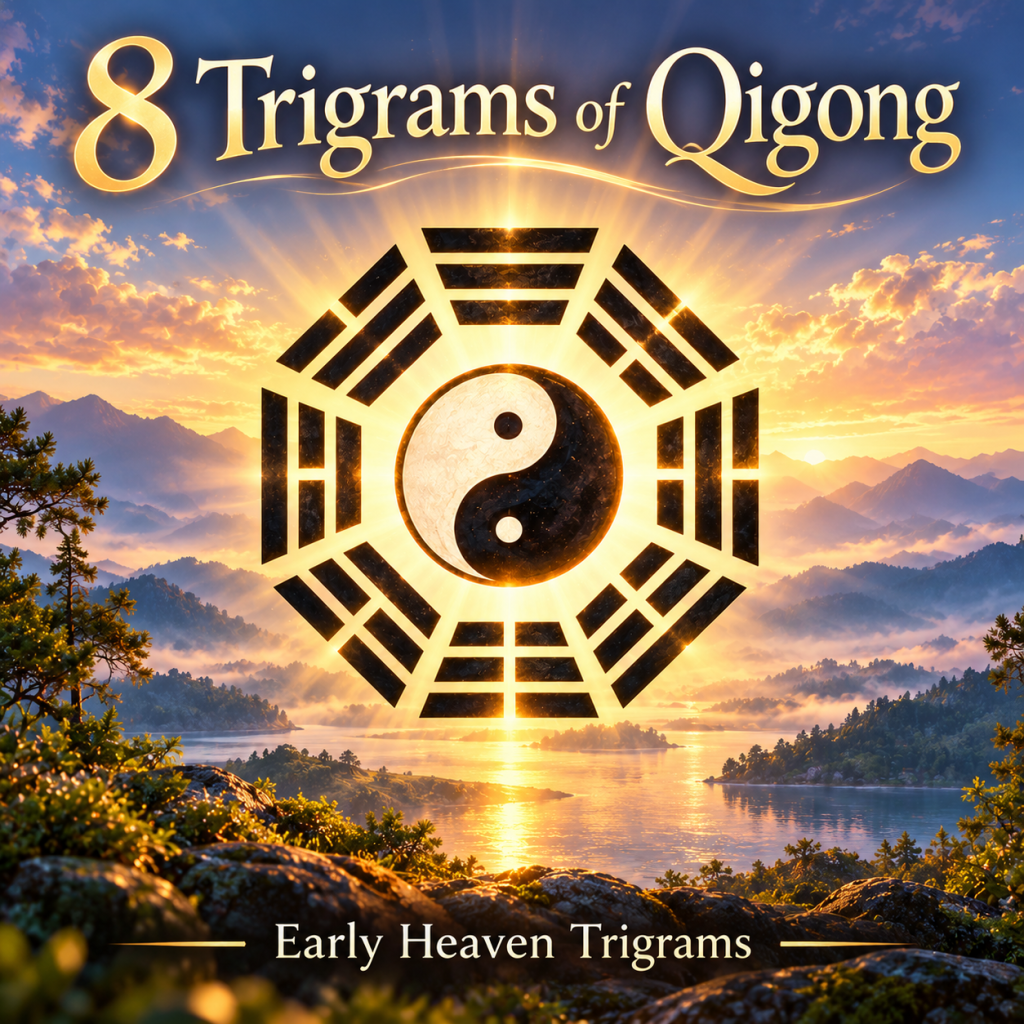
For thousands of years, Chinese philosophy has used eight simple symbols to represent eight forces found in nature: Heaven, Earth, Thunder, Wind, Water, Fire, Mountain, and Lake.
Each symbol is called a trigram. A trigram is made from just three lines. A solid line represents Yang energy, while a broken line represents Yin energy.
Together, the Eight Trigrams are called the Bagua (八卦). They became an important part of the I Ching, or Book of Changes, and later influenced Chinese philosophy, martial arts, Tai Chi, Qigong, and other traditional practices.
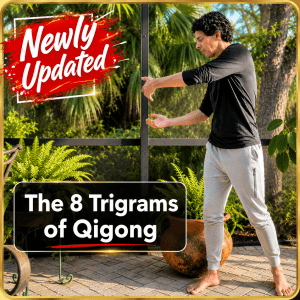
In our 8 Trigrams of Qigong practice, we explore these ideas through movement. Instead of only thinking about Heaven, Earth, Water, or Fire, we use the body, breath, and attention to experience qualities such as strength, softness, stillness, movement, balance, and flow.
Do the 8 Trigrams with Joe here.
What Are the Eight Trigrams?
Each trigram is made of three horizontal lines. A solid line (Yang) represents qualities such as activity, strength, and expansion. A broken line (Yin) represents qualities such as receptivity, softness, and yielding.
The lines are traditionally read from the bottom upward. When three Yin or Yang lines are combined, they create eight possible patterns—the Eight Trigrams.
Each trigram became associated with a force or image from nature:
- ☰ Qian — Heaven
- ☷ Kun — Earth
- ☳ Zhen — Thunder
- ☴ Xun — Wind/Wood
- ☵ Kan — Water
- ☲ Li — Fire
- ☶ Gen — Mountain
- ☱ Dui — Lake
These are more than pictures of nature. Traditionally, they also represent different qualities of change. Heaven can suggest creative strength. Earth can suggest receptivity. Thunder can suggest sudden movement. Wind can suggest gentle persistence. Water adapts and flows. Fire illuminates. Mountain represents stillness. Lake is associated with openness and joy.
The 8 Trigrams of Qigong with Joe
In this Club Qigong practice, we connect these ancient ideas with flowing Qigong movements. The exercise names below are part of our practice; they are not the traditional names of the trigrams themselves.
1. Throwing Away the Trash — ☰ Qian / Heaven
Heaven represents creative, expansive Yang energy. In Throwing Away the Trash, we use movement, breath, and the Six Healing Sounds as a practice of letting go.
Practice focus: Release tension, create space, and bring awareness to what you are ready to let go of.
2. The Wave — ☷ Kun / Earth
Earth represents receptivity, nourishment, support, and grounding. The Wave uses soft, continuous motion through the body and spine.
Practice focus: Grounding, relaxation, spinal mobility, and learning to move with less resistance.
3. Dragon Whips Its Tail — ☳ Zhen / Thunder
Thunder represents awakening, movement, and sudden change. Dragon Whips Its Tail brings more dynamic rotational movement into the practice.
Practice focus: Wake up the body, loosen tension, and explore responsive, energetic movement.
4. Filling the Three Dan Tians — ☴ Xun / Wind/Wood
Wind can be gentle, yet it reaches everywhere. Wood is associated with growth and expansion. This practice brings attention to the three Dan Tians, or traditional energy centers used in Qigong.
Practice focus: Breath, awareness, balance, and a sense of energy moving throughout the body.
5. Serving Teacups — ☱ Dui / Lake
Lake is traditionally associated with joy, openness, and ease. Serving Teacups uses smooth circular movements through the hands, wrists, arms, shoulders, and torso.
Practice focus: Relaxation, coordination, mobility, and finding an effortless sense of flow.
6. Rabbit Springs — ☵ Kan / Water
Water flows around obstacles rather than fighting them. It can be soft and adaptable while remaining remarkably powerful.
Rabbit Springs uses gentle rhythmic movement through the torso and lower body.
Practice focus: Fluidity, adaptability, comfortable movement, and awareness of the abdomen and center of the body.
7. Separating Heaven and Earth — ☲ Li / Fire
Fire represents brightness, warmth, and illumination. Separating Heaven and Earth creates an expansive stretch through the upper and lower body while coordinating movement with breath.
Practice focus: Opening the body, improving mobility, releasing tension, and cultivating an energized yet balanced feeling.
8. Spiral Palm — ☶ Gen / Mountain
Mountain represents stillness, stability, and grounded strength. Spiral Palm combines that stable foundation with smooth spiraling movement.
Practice focus: Coordination, balance, grounded movement, and gentle rotation through the body.
Yin, Yang, and the Eight Trigrams
The Eight Trigrams show something beautifully simple: nature is always changing.
Day becomes night. Winter becomes spring. Water can become ice or vapor. A storm arrives and passes. Everything moves between different qualities of Yin and Yang.
The trigrams provide a symbolic map for understanding those changes.
In Qigong, we can explore the same idea through our bodies. Sometimes a movement is strong; sometimes it is soft. Sometimes we rise; sometimes we sink. Sometimes we expand; sometimes we gather inward. Sometimes the practice is active; sometimes the most powerful thing we can do is become still.
The Trigrams of the I Ching
The Eight Trigrams come from the ancient Chinese tradition associated with the I Ching, also known as the Book of Changes.
Each trigram contains three lines:
- Solid line: Yang
- Broken line: Yin
The lines are read from bottom to top. Different combinations of Yin and Yang create the eight symbols.
Over centuries, the trigrams became associated with much more than their natural images. Traditional systems connect them with directions, seasons, family relationships, qualities of movement, and other patterns found in nature and human experience.
The exact correspondences can also vary depending on the traditional arrangement being used, such as the Earlier Heaven (Pre-Heaven) or Later Heaven (Post-Heaven) Bagua.
Bringing the Eight Trigrams Into Your Qigong Practice
You don’t need to memorize ancient Chinese philosophy to benefit from the idea behind the Eight Trigrams.
Start with nature.
Be strong like Heaven.
Grounded like Earth.
Awake like Thunder.
Gentle and persistent like Wind.
Adaptable like Water.
Bright like Fire.
Still like a Mountain.
And open like a Lake.
Then allow your Qigong practice to become more than a series of exercises. It becomes a way of exploring the same qualities of movement, balance, and change that we see everywhere in the natural world.
Practice the 8 Trigrams of Qigong with Joe here.
One important correction I made: I removed claims such as **“allows kundalini to pass through,” “wrings out the spleen and liver,” “purges anxiety,”** and **“improves elimination.”** They were unnecessarily strong and, in the case of kundalini, mix a primarily Indian yogic concept into a page explaining Chinese Bagua/Qigong.
I also removed **Dragon Ball** from the numbered eight because your original page accidentally had **nine different movements** across its two sections. The revised version gives you a clean one-to-one relationship: **8 trigrams → 8 movements**, while making clear that Joe’s exercise names are your Qigong interpretation, not the historical names of the Bagua.