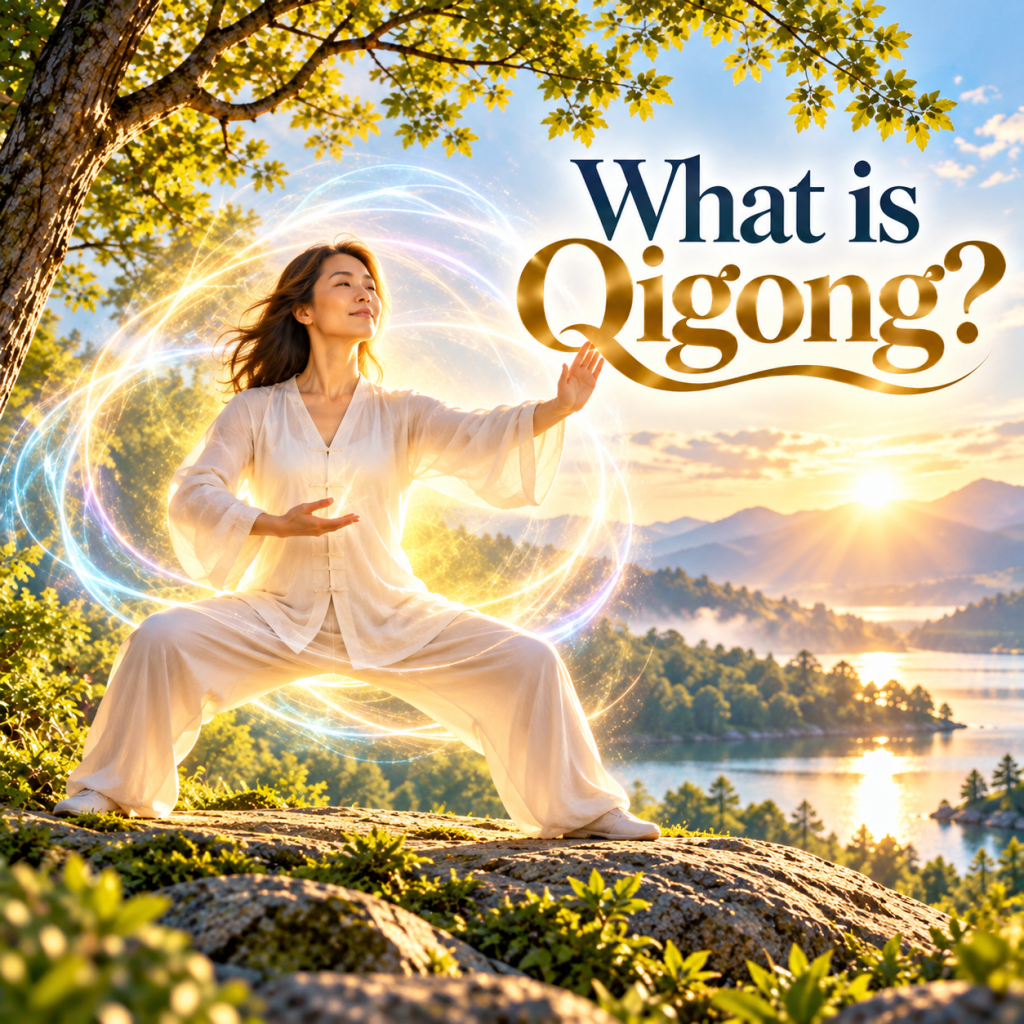
What is Qigong?
What Is Qigong?
Qigong is the physical manifestation of ancient Chinese medicine and a traditional Chinese mind-body practice that has been practiced in various forms for centuries. The word Qigong is commonly translated as the “cultivation of life-force energy.”
At its heart, Qigong combines gentle movement, intentional breathing, posture, meditation, relaxation, and focused awareness. Rather than treating the mind, body, and spirit as completely separate, Qigong approaches them as interconnected parts of the whole person.
This is one reason Qigong can look remarkably simple from the outside. A practitioner may be standing quietly, slowly raising and lowering the arms, shifting weight from one foot to another, coordinating a movement with the breath, or simply sitting in meditation. Yet the practice is about much more than the movement itself. The physical movement, breath, attention, and intention are brought together into one experience.
What Does Qigong Mean?
The simplest way to understand the meaning of Qigong is to look at the two words that make up its name:
Qi (or Chi) = life-force energy
Gong = skill, practice, work, or cultivation
Qigong = the practice or cultivation of life-force energy
In traditional Chinese philosophy, Qi refers to the vital energy or animating force associated with life and movement. Gong refers to developing a skill or ability through consistent practice. Qigong, therefore, can be understood as learning to cultivate, regulate, and work with Qi through dedicated practice.
How Does Qigong Work?
Qigong uses slow, mindful movement together with breathing and awareness. Instead of exercising only the muscles, the practitioner pays attention to the entire experience of moving: posture, balance, relaxation, breath, sensation, attention, and the quality of the movement itself.
A helpful way to think about Qigong is to look at nature. Water rarely moves in rigid, abrupt lines. Trees bend with the wind. Waves rise and fall. The seasons expand, contract, rest, and begin again.
Qigong teaches us to move more like nature moves — smoothly, rhythmically, efficiently, and with less unnecessary tension.
In traditional Qigong and Chinese medicine, this is often described as encouraging the smooth movement of Qi throughout the body. From a modern perspective, many Qigong practices also involve elements familiar from other forms of mind-body exercise: gentle physical activity, balance, controlled breathing, relaxation, body awareness, and meditation.
What Is Qigong Used For?
People practice Qigong for many different reasons. Some begin because they want a gentle form of exercise. Others are interested in meditation, stress reduction, balance, flexibility, healthy aging, traditional Chinese philosophy, or simply feeling more connected to their bodies.
Traditional Qigong practice has long emphasized maintaining balance and cultivating health before problems arise. Rather than waiting until the body feels completely depleted, the philosophy encourages regular practices that support balance, movement, rest, awareness, and vitality throughout life.
For many people, Qigong becomes less about “doing an exercise” and more about developing a different relationship with their body and mind.
What Are the Benefits of Qigong?
Qigong is practiced around the world as a form of gentle mind-body exercise. Depending on the style and the individual, people may practice Qigong to support:
- Relaxation and stress management
- Gentle daily movement
- Balance and coordination
- Mobility and flexibility
- Mindful breathing
- Body awareness
- Meditation and mental focus
- Healthy aging and continued movement
- A greater sense of calm and well-being
- Connection between the body, breath, and mind
Qigong should not be viewed as a replacement for appropriate medical care. Instead, it can be practiced as part of a broader approach to movement, mindfulness, relaxation, and personal well-being.
Is Qigong a Form of Meditation?
Yes. Qigong can be thought of as both movement and meditation.
Some Qigong exercises involve flowing physical movements, while others involve standing, sitting, breathing, visualization, or stillness. In moving Qigong, the movement itself can become the object of meditation. You feel the feet connecting with the ground, notice the breath, observe sensations in the body, and bring your attention back to the present moment.
This is why Qigong is sometimes described as meditation in motion.
Is Qigong the Same as Tai Chi?
Qigong and Tai Chi are closely related, but they are not exactly the same thing. Both developed from Chinese traditions and commonly incorporate posture, breathing, awareness, relaxation, and flowing movement.
Qigong is a broad category containing many different exercises, practices, breathing techniques, meditations, and systems of movement. Tai Chi developed as a Chinese martial art and is generally practiced through specific sequences or forms, although today many people also practice Tai Chi primarily for health, balance, relaxation, and meditation.
A beginner may find that individual Qigong movements are easier to learn because they can often be practiced independently and repeated for several minutes without memorizing a long sequence.
Can Beginners Practice Qigong?
Absolutely. Qigong can be remarkably beginner-friendly. You do not need to be flexible, athletic, young, or experienced with meditation.
Many Qigong movements are slow and can be adjusted to suit your comfortable range of motion. Some practices can also be performed while seated, making Qigong accessible to people who may find conventional exercise difficult.
The goal is not to force your body into a perfect position. Qigong is about developing awareness and gradually learning how to move with greater ease.
How Long Should You Practice Qigong?
You do not need to practice Qigong for hours to begin developing a routine. A short daily practice can be a wonderful place to start.
For beginners, even 5 to 10 minutes of Qigong can introduce the basic principles of mindful movement and breathing. As the practice becomes familiar, you may naturally want to spend more time with it.
Consistency is generally more important than trying to make every session long or perfect.
The Deeper Philosophy of Qigong
The deeper lesson of Qigong is not simply learning a collection of movements. It is learning to notice.
Where are you holding tension? How are you breathing? Are you forcing the movement or allowing it? Can you remain relaxed while your body is active? Can you notice what is happening without immediately judging it?
These simple questions begin on the practice floor, but they can eventually follow you into everyday life.
Qigong teaches us to move the way nature moves — with greater awareness, adaptability, balance, and flow.
That is why Qigong can be much more than exercise. It can become a daily practice of returning to the body, quieting the mind, cultivating energy, and becoming more present for the life that is already happening.
Beginning Your Qigong Practice
If you are completely new to Qigong, begin simply. Stand or sit comfortably. Relax your shoulders. Allow your breathing to become natural. Move slowly and within a range that feels comfortable for your body.
You do not need to understand every concept surrounding Qi before you begin. Qigong is experiential. With practice, you begin to understand it through movement, breath, stillness, and awareness.
We welcome you to this fun and profound journey. 🙏
In good Qi,
Joe & Melissa