
Qigong for Balance & Vertigo
Understand Vertigo and Restore Balance
Sometimes vertigo feels like your body hit the wrong button and suddenly the world starts moving without your permission.
Not exactly a peak wellness moment.
One minute you are standing there minding your own business, and the next it feels like the room is spinning, your footing is questionable, your stomach joins the chat, and your confidence drops a few floors.
It can be unsettling fast.
From a Qigong and Traditional Chinese Medicine perspective, vertigo is not just a random glitch. It is often a sign that your system has lost some harmony between head and body, rising and sinking, stillness and movement, root and branch.
In plain English: the upper body is getting too much activity while the lower body is not giving enough support.
That is why in Qigong, we do not just chase the symptom. We return the whole system to center.
Why Vertigo Happens (Qigong + TCM View)
In Western language, vertigo is often connected to the inner ear, neurological issues, inflammation, or positional changes.
But in Qigong, we ask a deeper question:
What is the Qi doing?
Usually, vertigo shows up when energy is not being managed well between the top and bottom of the body.
Either too much rises, too little anchors, or something muddy blocks the clear sensory pathways.
Common energetic patterns:
🌿 Liver Yang Rising
Energy rushes upward too strongly. Think pressure, irritability, headaches, dizziness.
🌿 Internal Wind
Movement without stability. Spinning, shakiness, disorientation.
🌿 Phlegm Misting the Head
Foggy, heavy, cloudy dizziness. More like energetic congestion than literal mucus.
🌿 Kidney Deficiency
Weak root system. Not enough deep reserve energy to stabilize you.
🌿 Qi and Blood Deficiency
Not enough nourishment reaching the head clearly. Leads to lightheadedness and fatigue.
The takeaway: vertigo often means your system needs grounding, regulation, and better communication between upper and lower body.
The Golden Principle: Root Before You Rise
This is where most people get it backwards.
They try to fix vertigo by focusing on the head.
Qigong says: do the opposite.
Drop awareness down. Rebuild the root.
Your core actions:
🌀 Sink the Qi
🌀 Soften the breath
🌀 Relax the neck and jaw
🌀 Feel the feet
🌀 Strengthen the lower center (Dantian)
🌀 Calm the Shen (mind/spirit)
When the lower body stabilizes, the upper body stops overreacting.
When the nervous system settles, the spinning loses intensity.
Why Qigong Works So Well
Qigong does not try to overpower the body. It works with it.
🌱 Gentle movement improves circulation
🌱 Breath calms the nervous system
🌱 Awareness reconnects the body
🌱 Stillness reduces internal chaos
Less force. More intelligence.
Qigong is not just exercise. It is energetic re-education.
Foundational Principles for Relief
🌼 Slow everything down
Fast movement overwhelms a sensitive system.
🌼 Keep the eyes soft
Hard focus increases strain.
🌼 Relax the neck and jaw
Tension here amplifies dizziness.
🌼 Breathe lower
Chest breathing keeps you in stress mode.
🌼 Feel your feet
Your grounding system starts here.
🌼 Use less effort
Subtle beats force in Qigong.
Simple Practices That Actually Help
🌿 Wuji Standing (The Reset)
Stand with soft knees, relaxed arms, loose jaw.
Feel your feet. Let your breath settle.
This is not doing. This is undoing.
🌿 Sinking the Qi
On each exhale, feel energy drop into your lower abdomen.
Think: melting downward.
🌿 Gentle Swaying
Tiny movements. Barely noticeable.
Helps retrain balance safely.
🌿 Seated Qigong
Bad day? Sit.
Still breathe. Still move gently.
Still counts. Big time.
🌿 Soft Neck Release
Small movements. No aggressive stretching.
Relax the jaw. Soften the eyes.
🌿 Breath Regulation
🌬 Inhale gently through the nose
🌬 Exhale slower than you inhale
🌬 Let the belly soften
This tells your nervous system: you are safe.
Emotions Are Not Optional Here
Emotions are everything.
🌊 Anxiety pushes energy upward
🌊 Fear weakens grounding
🌊 Overthinking traps energy in the head
This is not blame. It is awareness.
When emotions settle, energy organizes.
When energy organizes, the body stabilizes.
Common Mistakes to Avoid
🚫 Moving too fast
🚫 Over-practicing
🚫 Forcing breath
🚫 Overanalyzing symptoms
🚫 Locking the knees
🚫 Ignoring fatigue
Qigong is cooperation, not control.
A Simple Daily Flow
☀️ 2–5 minutes Wuji standing or seated
☀️ 2–3 minutes gentle breathing
☀️ 3–5 minutes slow movement or swaying
☀️ 1–2 minutes hands on lower Dantian
☀️ 1 minute stillness
That is enough to start shifting things.
The Heart of the Remedy
✨ Slow down
✨ Soften
✨ Feel your feet
✨ Relax the upper body
✨ Breathe lower
✨ Let awareness descend
✨ Strengthen your root
Vertigo can make life feel unstable.
Qigong teaches you how to become the ground again.
Not by force.
Not by panic.
But by returning… again and again… to center.
Featured image prompt: A peaceful, realistic wellness scene of a person practicing gentle Qigong outdoors at sunrise, grounded stance, soft flowing hands, warm golden light, calm expression, natural setting, cinematic, representing balance, stability, and vertigo relief.
Qigong Routines for Balance and Vertigo
Here are some Qigong tips, tricks, and movements that might help manage vertigo:

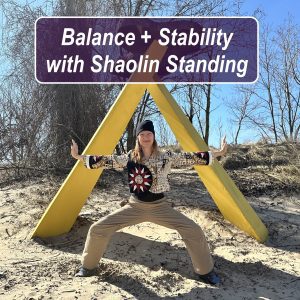
💪 Shaolin Standing for Balance (a form of Zhan Zhuang)
Shaolin Standing is highly effective for vertigo as it retrains balance, strengthens stabilizing muscles, and improves inner ear function. By holding a rooted stance, it enhances proprioception, recalibrates the brain’s balance signals, and promotes blood flow to the head, reducing dizziness. The deep, meditative breathing calms the nervous system, lowering anxiety-related vertigo, while the strong postural engagement prevents instability and falls. Over time, this practice naturally restores equilibrium, making it a powerful, holistic approach to vertigo relief.
Full Routine Here
More Routines for balance and stability:
🌬 Shaking the Tree (Qi Shower)
This movement involves gentle shaking of the entire body, starting from the feet and moving upwards, which helps to relax the muscles and clear the mind. It’s believed to dispel negative energies and stress, improving the flow of Qi throughout the body.
Full Routine Here
🌿 The Eight Silk Brocades (Ba Duan Jin)
This is a set of eight exercises that are excellent for enhancing general health and balancing the body’s energy. Specific movements within the Eight Brocades can be particularly beneficial for vertigo, such as:
– Two Hands Hold up the Heavens: This move stimulates the Triple Burner, which helps harmonize the energy levels of the body.
– Looking Backwards: This can prevent and cure tension and neck issues, which are sometimes linked to vertigo.
Full Routine Here
🚶♂️ Walking Qigong
This form involves walking in a relaxed and mindful manner, coordinating the breath with slow, deliberate steps. It’s excellent for grounding the body’s energy and can be very stabilizing for those experiencing vertigo.
Full Routine Here
Additional Tips:
📅 Regular practice: Consistency is key in Qigong. Regular practice can help maintain the balance of Qi in the body, preventing episodes of vertigo.
🌬 Deep, abdominal breathing: This helps to calm the mind and stabilize the body, reducing the likelihood of vertigo attacks.
🕴️ Focus on posture: Maintaining a good posture during exercises ensures the correct flow of Qi, which can prevent the imbalance that leads to vertigo.
Integrating these practices into your routine might help alleviate the symptoms of vertigo. However, it’s important to approach these exercises with patience and, if possible, under the guidance of a knowledgeable Qigong instructor or TCM practitioner to ensure they are done correctly and safely.
Access Your Free Qigong Flow & Meditation with Joe by Joining Our Newsletter